Overview of the Fifth Circuit’s Decision

The United States Court of Appeals for the Fifth Circuit (“Fifth Circuit”) handed certain partners in limited partnerships within its jurisdiction a huge win regarding self-employment tax. In Sirius Solutions, L.L.L.P. v. Commissioner,[1] a divided Court of Appeals held that a limited partner for purposes of the self-employment tax exception under Internal Revenue Code (“IRC” or “Code”) Section 1402(a)(13) means a partner in a limited partnership with limited liability, i.e., a limited partner under state law. In so holding, the Fifth Circuit rejected the Tax Court’s application of the Renkemeyer[2] “functional analysis test” and the government’s arguments that “limited partner” only refers to “passive investors” in a limited partnership.

The Code imposes a tax on “self-employment income,” which is defined as “the net earnings from self-employment.”[3] The tax is imposed on self-employed individuals, including individuals that are partners in a partnership. However, IRC Section 1402(a)(13) excludes the distributive share of income of a “limited partner, as such,” from the net earnings from self-employment (the “1402(a)(13) exception”). The term “limited partner” is not defined in the statute. As expected, the Social Security law also contains an identical exception for purposes of computing Social Security benefits to maintain symmetry between the taxes an individual pays and the benefits an individual is entitled to receive.[4]

Background of the Sirius Solutions Dispute

Based on the 1402(a)(13) exception, Sirius Solutions L.L.L.P., a Delaware limited liability limited partnership, excluded its limited partners’ distributive share of partnership income from its calculation of net earnings from self-employment for the 2014 through 2016 tax years. On audit, the Internal Revenue Service (“IRS”) determined that Sirius Solutions’ state law limited partners did not qualify as limited partners for purposes of the 1402(a)(13) exception because the exception only applies to passive investors.

Sirius Solutions contested the IRS’s determination and asserted that the meaning of the term “limited partner, as such” meant a limited partner under state law with limited liability. Relying on its decision in Soroban Capital Partners, LP v. Commissioner,[5] the United States Tax Court held that “limited partner, as such,” for purposes of the 1402(a)(13) exception, only refers to passive investors. Sirius Solutions appealed.

The Fifth Circuit’s Textual Analysis

Judge Oldham, writing for the majority, began by reviewing the statute’s text and dictionary definitions of “limited partner” to ascertain the ordinary meaning of the term “limited partner” at the time the statute was enacted. These 1977-era definitions convinced the majority that the “touchstone” for the term “limited partner” was limited liability.[6] The majority also held that the words “as such” following “limited partner” did not detract from that meaning but were intended to clarify how individuals who serve as both a limited and general partner are to be taxed. In addition, the majority noted that if Congress wished to only exclude passive investors from the tax, it could have easily written the exception to do so, just as it had used the term “passive investor” in other provisions of the Code.

Agency Interpretations Support Limited Liability Meaning

The majority opinion then turned to interpretations of “limited partner” by two federal agencies—the Social Security Administration (“SSA”) and the IRS. With respect to the agency determinations, the court found that the IRS and SSA have “contemporaneous, longstanding, and consistent” interpretations of the term “limited partner,” including in the IRS’s instructions to its Form 1065, U.S. Return of Partnership Income, as well as the SSA’s rules related to the identical exception for computing Social Security benefits, to mean a partner with limited liability in a limited partnership. Together with the dictionary definitions, the majority held that the term’s “single, best meaning” is a partner in a limited partnership that has limited liability.

The court further explained that it is not the taxpayer’s label as “limited partner” that allows the taxpayer to qualify for the 1402(a)(13) exception but rather the substantive interests created under state law. Thus, a taxpayer in the “hypothetical State of West Carolina” labeled as a “limited partner” under state law even though he or she was a sole proprietor, would not be considered a “limited partner” for purposes of IRC Section 1402(a)(13); however, a taxpayer in the “hypothetical State of East Carolina” labeled as “schlimited bartner” under state law but nonetheless a member of a limited partnership with limited liability, would qualify for the 1402(a)(13) exception.[7]

Role of State Law in Federal Tax Interpretation

In response to the IRS’s assertions that federal law, not state law, controls the interpretation of federal tax statutes and that federal tax law should be interpreted uniformly nationwide, the majority noted that to determine the federal meaning of “limited partner” necessarily requires a review of state law to determine if the preconditions of the federal statutory definition are satisfied, because “limited partnerships are creatures of state law, not federal law.”[8]

Scope of the Decision

It should also be noted that in a footnote, the majority limited the scope of its decision to membership in a limited partnership, stating that its discussion did not extend to members of another entity such as a limited liability partnership or a limited liability company.[9]

Having so ruled, the Fifth Circuit vacated and remanded the case for further proceedings consistent with the opinion, holding that a “limited partner” under the 1402(a)(13) exception “is a limited partner in a state-law limited partnership that is afforded limited liability.”[10]

Implications and Practical Considerations

The implications of the Fifth’s Circuit’s decision in Sirius Solutions are unclear and it is likely the government will appeal the decision. At present, two cases with the same issue, Soroban Capital Partners LP v. Commissioner[11] (Second Circuit), and Denham Capital Management LP v. Commissioner[12] (First Circuit), are currently pending in other United States Circuit Courts of Appeals. Another case, Point72 Asset Management LP v. Commissioner[13] (Second Circuit) is currently pending before the Tax Court. If the event a circuit split occurs, a significant amount of uncertainty could arise absent action by Congress or the United States Supreme Court.

In light of this decision, taxpayers who are partners in a limited partnership with limited liability within the Fifth Circuit (states such as Texas and Louisiana) fall into the 1402(a)(13) exception and their distributive shares of income are excluded from the net earnings from self-employment, and thus from self-employment tax liability. As long as a partner retains their status as a limited partner under state law, it does not matter how active that partner is in the business of the partnership or how many services the partner performs for the partnership to be eligible for the 1402(a)(13) exception, which may lower the self-employment tax liability of any limited partner that included their distributive share in their net earnings from self-employment.

It is possible the Fifth’s Circuit’s decision in Sirius Solutions could correspondingly result in a reduction in Social Security benefits of any person residing in the Fifth Circuit who paid self-employment tax on their self-employment income from a limited partnership as a result of the identical exception in 42 U.S.C. 411(a)(12), which would seemingly result in the removal of a limited partners’ self-employment income from the benefits calculation. It is not clear if or when such a reduction would occur or how significant such a reduction would be given that the Fifth Circuit’s decision is restricted to limited partnerships and limited liability limited partnerships at present. Thus, any person residing in the Fifth Circuit that remitted self-employment tax on their distributive share from a limited partnership should consider whether it is appropriate to file protective refund claims for all open tax years.

In addition, a resident taxpayer that is a limited partner in a limited partnership should consider their filing options going forward, e.g., whether to pay the self-employment tax and file a protective refund claim, thereby mitigating interest risk but losing the potential returns on the funds used to pay the tax for a period of time, or whether to not pay self-employment tax on their distributive share from a limited partnership and accept the risk of additional liability in the event Congress or the Supreme Court overturns Sirius Solutions.


For additional information, please contact: Jaye Calhoun at (504) 293-5936, Willie Kolarik at (225) 382-3441, Divya Jeswant at (504) 293-5766, Kevin Baker at (713) 844-3007, or Derek Brondum at (337) 422-3667.

Jaye Calhoun, Willie Kolarik, Divya Jeswant, Kevin Baker, and Derek Brondum are members of Kean Miller’s Tax group, which advises a variety of clients on federal, state and local tax (SALT), and estate planning matters. The team works collaboratively to develop practical, multidisciplinary strategies that anticipate issues, minimize risk, and resolve complex tax issues efficiently, whether through negotiations or formal litigation proceedings.


[1] Sirius Solutions, L.L.L.P. v. Commissioner, No. 24-60240, slip op. (5th Cir. Jan. 16, 2026).

[2] Renkemeyer, Campbell & Weaver v. Commissioner, 136 T.C. 137 (2011).

[3] IRC §§ 1401(a), 1402(b).

[4] 42 U.S.C. 411(a)(12).

[5] Soroban Capital Partners LP v. Commissioner, 161 T.C. 310 (2023).

[6] Sirius Solutions, L.L.L.P. v. Commissioner, No. 24-60240, slip op. at 7 (5th Cir. Jan. 16, 2026).

[7] Id. at 17.

[8] Id. at 16-17.

[9] Id. at 5.

[10] Id. at 24.

[11] Soroban Capital Partners LP v. Commissioner; (T.C. Memo. 2025-52).

[12] Denham Capital Management LP v. Commissioner (T.C. Memo. 2024-114).

[13] Point72 Asset Management, L.P. v. Commissioner (T.C. Docket No. 12752-23).

Texas litigators have long relied on established methods of service such as personal delivery, certified mail, substituted service at a residence or workplace and, when those efforts fail, service by publication. As defendants have become increasingly difficult to locate through traditional means, however, many nonetheless maintain an active online presence. In response to this shift, the Texas Supreme Court amended Rule 106 to permit court-authorized electronic substituted service.

Rule 106(b)(2): Electronic Substituted Service

Effective December 31, 2020, Texas Rule of Civil Procedure 106(b)(2) authorizes courts to permit substituted service “in any other manner, including electronically by social media, email, or other technology,” provided the proposed method is reasonably effective to give the defendant notice of the suit.

Under the amended rule, Texas courts may authorize service through platforms such as Facebook, LinkedIn, Instagram, X, email, or other technology. Electronic service, however, is not automatic. It remains a form of substituted service that requires prior court authorization and strict compliance with the rule’s evidentiary requirements.

How Courts Evaluate Requests for Social-Media Service

Texas courts apply a largely consistent framework when evaluating requests for service by social media. Courts generally consider whether the plaintiff first attempted traditional methods of service, whether the social-media account at issue belongs to the defendant, and whether the defendant has actively or recently used that account.

Courts also assess whether the proposed method of service is reasonably calculated to provide notice under due-process standards and whether the plaintiff can later demonstrate that service was in fact accomplished. Because substituted service implicates due-process concerns, the supporting affidavit must strictly comply with Rule 106(b)(2). The Texas Supreme Court has specifically instructed courts to consider “whether the technology actually belongs to the defendant and whether the defendant regularly uses or recently used the technology.”

Facebook Service Approved: Chrisenberry v. Ketcher

In Chrisenberry v. Ketcher (W.D. Tex. 2022), the court authorized service via Facebook after multiple unsuccessful in-person service attempts at the defendant’s last known address. The plaintiff submitted sworn affidavits from two process servers and presented evidence that the Facebook account was active and belonged to the defendant. The plaintiff also identified the defendant in photographs posted to the account and location data associated with the account aligned with the defendant’s known history.

Based on this evidentiary record, the court authorized service via Facebook, with service by publication permitted if electronic service proved unsuccessful.

When Email Service Falls Short: NexBank v. ResMac

By contrast, in NexBank v. ResMac (N.D. Tex. 2025), the court rejected a request for service by email while approving alternative service by first-class mail only. The court found that the record contained no evidence establishing that the email address in question belonged to the defendant or was being actively used.

Citing CT Cash LLC v. Anns Boyz Logistics Inc. (N.D. Tex. 2023), the court reiterated that service by email is appropriate only where a plaintiff demonstrates both diligent efforts at traditional service and recent use of the email address by the defendant. Courts have therefore often found email service more difficult to substantiate than service via social media, given the greater ability to verify ownership and recent use of social-media accounts.

International Defendants and Social-Media Service

In the international context, Cothran v. Koomson (E.D. Tex. 2021) involved a defendant believed to be located in Ghana with no known physical address. Three private investigators traced IP address data to Ghana and demonstrated that the defendant actively used Facebook, including by regularly changing profile photographs. The alleged fraud itself occurred through social media further linking the platform to the defendant.

Although the court analyzed potential issues relating to international service, it ultimately concluded that service by Facebook was not prohibited by any applicable international agreement and authorized service through that platform.

Key Takeaways from Recent Decisions

Taken together, these decisions reflect a consistent legal framework. Courts are generally receptive to service by social media where the record demonstrates multiple documented attempts at traditional service, verified ownership of the account, and recent activity showing that the platform is actively used by the defendant.

By contrast, courts remain skeptical when account ownership is unverified or speculative, the platform appears dormant, electronic service is used as a substitute for diligent efforts at traditional service, or the supporting affidavits are conclusory or unsupported by evidence.

Practical Guidance for Practitioners

For practitioners, these recent developments confirm the growing acceptance of electronic substituted service. Since the 2020 amendment to Rule 106, courts have increasingly approved such service where plaintiffs meet the rule’s requirements. Properly applied and supported by competent evidence, Rule 106(b)(2) affords a constitutionally sound means of effecting service on elusive defendants.


Farnaz Alms is a member of Kean Miller’s Offshore Energy & Marine group and practices in the firm’s Houston office. She is an experienced state and federal court litigator who handles complex offshore disputes, including maritime and admiralty matters, securities litigation, toxic tort claims, and a wide range of commercial disputes.

This year, Texas enacted a procedural change with notable consequences for companies and individuals affected by litigation beyond the state’s borders. Effective August 31, 2025, the Texas Supreme Court adopted the Uniform Interstate Depositions and Discovery Act (“UIDDA”), bringing Texas in alignment with the procedural framework already used by the vast majority of U.S. jurisdictions. Through the creation of Texas Rule of Civil Procedure (“TRCP”) 201.3, Texas effects a major change in how out-of-state subpoenas and interstate discovery will be handled in future proceedings.

Texas Was a Subpoena Outlier

For decades, Texas maintained a more formal and onerous approach to handling foreign subpoenas. Parties seeking discovery here were required to first initiate a miscellaneous proceeding in a Texas court, secure involvement of local counsel, and navigate various procedural hurdles. The UIDDA replaces that framework with a more streamlined, straightforward administrative process.

Changes for Out-of-State Subpoenas

Under new Rule 201.3, an attorney involved in litigation pending in another jurisdiction may now present the out-of-state subpoena to a Texas court clerk. The clerk, in turn, issues a Texas subpoena that reflects the terms of the original. From that point on, all aspects of compliance (service, objections, protective orders, and enforcement) proceed under Texas law and within Texas courts. This means that TRCP 176 governs service and enforcement, Texas’s proportionality standards under Rule 192.4 still apply, and burdens, deadlines, and protections are assessed according to Texas discovery rules. Likewise, Texas’s unique procedures for protecting confidential information, trade secrets, and privileged materials under Rule 192.6 remain fully in effect. And, significantly, any disputes related to the foreign subpoena must be resolved in the Texas county where discovery is to occur.

Corporate representative depositions and document requests also remain subject to Texas rules. A UIDDA subpoena seeking, for example, an FRCP 30(b)(6)-style deposition must satisfy Texas Rule 199.2(b)(1), and document requests must follow Texas formatting and timing requirements. Thus, while the initial steps of domesticating a subpoena have become considerably easier, the substantive protections and procedural expectations to which Texas litigants are accustomed remain firmly in place.

Texas Conforms to National Subpoena Standards

Texas was one of the last hold outs of the UIDDA and its adoption places the state within the overwhelming national majority that follows the framework. Enacted in 2007, the UIDDA has now been adopted by nearly every U.S. jurisdiction, leaving only Massachusetts and Missouri as the remaining non-adopters. Texas’ adoption of the UIDDA should ease much of the confusion that once surrounded out-of-state subpoenas. The process is now simpler and more consistent, especially for those who rarely encounter such requests. It will help create predictability for businesses that operate in interstate environments, reduce procedural friction, and ensure that Texans who find themselves connected to litigation elsewhere respond to subpoenas under a familiar set of rules.


Farnaz Alms and Stacey Norstrud are members of Kean Miller’s Offshore Energy & Marine group, practicing in the firm’s Houston office. The team represents a wide range of clients in litigation, transactions, and regulatory matters involving offshore oil and gas exploration, decommissioning, drilling activities, barges, tugs and towage, marine insurance, and other maritime and energy related matters.

In the wake of a recent and markedly successful U.S.-China trade mission, the Office of the United States Trade Representative (“USTR”) has issued a formal notice suspending the actions and sanctions previously levied under Section 301 of the Trade Act. The USTR – at the direction of President Trump – first announced the proposed suspension on November 6, 2025, following the White House’s November 1, 2025 proclamation of a historic trade deal having been reached between President Trump and China President Xi Jinping. The Office of the USTR also issued a Request for Comments on Suspending Section 301 Action for One Year: China’s Targeting of the Maritime, Logistics, and Shipbuilding Sectors for Dominance. The comment period – while uncharacteristically brief – applied only to the USTR’s November 6, 2025 notice. The majority of those comments supported the proposal to suspend the trade action. The USTR has extended comments to its October 16, 2025 notice through November 12, 2025.

The impetus behind the trade and economic deal struck between the world’s two-largest-economic powers emanated from a strong desire to safeguard U.S. economic strength and national security. To bolster those concepts China has agreed to help stop the outward flow of substances used in fentanyl production, eliminate export controls on rare earth elements and select critical minerals, end retaliation against certain U.S. manufacturers and semiconductor producers, and expand its purchasing market to U.S. agricultural products, particularly soybeans. The U.S. will in turn lower tariffs on Chinese imports – although a 10% is expected to remain in place during the suspension, extend the expiration of certain Section 301 tariff exclusions, and suspend implementation of other trade sanctions.

The noticed suspension went into effect on November 10, 2025 and shall likely stay in place for one year, or until end of day November 9, 2026, unless the USTR deems further actions appropriate in advance of the suspension deadline. The suspension period will be marked by a cessation on fees for maritime transport services under Annexes I, II, or III of the April 23, 2025 notice, as modified by the October 16, 2025 notice, which pertain to Chinese-operated, Chinese-owned, and foreign-origin car carriers, respectively. Additionally, neither the U.S. nor China will accrue any liability for duties, which would otherwise be levied under Annex V. A of the October notice. The penalty pause comes as a welcomed relief to those operators, ports, and transportation professionals and entities subject to financial setback due to the mutual-retaliatory trade policies. The respite from fees and tariffs may also allow the U.S. to enhance its efforts to strengthen domestic trade policy and work with select vendors and contractors to revitalize, reimagine, and reform the U.S. Shipbuilding industry, while welcoming foreign economic participation and investment from trusted partners.

Will the temporary suspension serve to lower global shipping costs and offset the impact of commercial-supply-chain disruption? Will it allow the current administration time to identify creative solutions to attract investment into American-built ships? Will it mitigate the higher prices and negative impact experienced by domestic industry sectors heavily reliant on international trade? And what will the fee and penalty schedule look like at the conclusion of the suspension? Opportunities for enhanced trade and supply-chain modifications abound. For more information concerning answers to these and other international trade and trade-finance queries, please contact international trade, supply-chain, and trade-finance professional, Stephen Hanemann, at stephen.hanemann@keanmiller.com.


Stephen Hanemann guides some of the world’s most advanced and sophisticated companies through leveraging their trade, finance, and logistics-related challenges and opportunities. Stephen believes in real-time, practical legal solutions for clients engaged in admiralty and maritime operations, intermodal and multi-modal shipment; project and asset-acquisition finance; import-export and customs regulation compliance.

Signed into law on July 4, 2025, the One Big Beautiful Bill Act (OBBBA) permanently reshapes the estate, gift, and generation-skipping transfer (GST) tax landscape. For high-net-worth individuals and families, these changes deliver clarity and opportunity—but only if acted on thoughtfully. For those who are under the new higher exemption amounts and who have overplanned in the past, you may risk losing other valuable tax benefits as a result of assets being outside of your estate. In that case, there are opportunities to bring those assets back into your estate, minimizing capital gains taxes for overall tax efficiency.

Permanent Increase in Exemptions
Starting January 1, 2026, the federal estate, gift, and GST tax exemptions are elevated to $15 million per individual (indexed for inflation). A married couple can now shelter up to $30 million from federal transfer taxes, permanently (or at least until Congress changes the rules again).

GST (Generation-Skipping Transfer) Tax Alignment
The GST exemption now matches the $15 million unified exemption. However, unlike the estate tax exemption, which can be “ported” over to the surviving spouse at the first death, GST exemption portability between spouses is not possible. This means that when one spouse dies, their generation-skipping tax exemption dies with them. This requires careful planning—such as separate trust structures—to fully utilize both spouses’ GST exemptions.

Tax Rate Holds Steady at 40%
For estates exceeding the exemption, tax is calculated on the excess amount at the longstanding 40% rate.

Strategic Opportunity: ‘Gift Now’ Advantage
Appreciation on assets that are outside of your taxable estate escapes future estate tax. If assets grow faster than inflation adjustments to the exemption, delaying gifts and keeping these appreciated assets in your estate can cause your estate to pay additional tax.

When you make lifetime gifts, you use up some or all of your federal exemption (now $15 million per person under the OBBBA). Here’s why doing so is often better than simply waiting until death for the estate tax to apply:

  1. Shrink the Taxable Estate
    • Every dollar you give away during your life (above annual exclusion gifts) reduces the size of your taxable estate.
    • Example: If you have a $40M estate and gift $15M today, your estate at death starts at $25M instead of $40M. That $15M (plus any future growth) is completely out of the estate tax calculation.
  2. Move Growth Out of the Estate
    • Assets given away today don’t just escape current taxation – all future appreciation on those assets also grows outside your taxable estate.
    • Example: A $15M business interest that grows to $30M over your lifetime would generate a $6M tax bill at 40% if left in the estate. If gifted now, both the $15M and the $15M in growth are free of estate tax, reducing a $6 million tax bill to zero.
  3. Leverage Valuation Discounts & Planning Structures
    • Lifetime transfers can often be made using FLPs, LLCs, or minority interests, which may qualify for valuation discounts (for example, lack of marketability and minority interest).
    • Such discounts are usually not available at death, meaning lifetime transfers can remove more value per dollar of exemption used.
  4. Psychological & Legacy Benefits
    • If you give away during life rather than at death, you get to watch your heirs enjoy the assets you gift. (For more on this paradigm-shifting philosophy, I highly recommend the book “Die With Zero” by Bill Perkins).
    • You can also use trusts to provide structure and asset protection while still moving assets out of the estate.

Bottom Line: Gifting during life isn’t just about using the exemption — it’s about shifting both the assets and all their future growth out of the estate, potentially saving millions in estate tax and creating an incredible legacy for your family or for charity.

Tax Planning Certainty & Permanency
The OBBBA removes the sunset of the enhanced exemptions scheduled under the 2017 Tax Cuts and Jobs Act (“TCJA”), offering long-term planning confidence.

One thing to consider: if your estate is BELOW the new permanent exemption and was created at a time when the exemption was much lower, you may have overplanned, which could cause loss of other valuable tax benefits, such as the step-up in basis at death, which eliminates capital gains taxes. If your estate falls in this category, contact us about how to “undo” what was previously done to maximize overall tax efficiency.

State-Level Considerations
State estate or inheritance taxes remain a separate layer of planning. For example, New York still has its own estate tax with a much lower exemption and a harsh “cliff” that causes taxation of the entire estate if the total amount is over $7,518,000 (for 2025). Federal tax relief doesn’t eliminate the need for state-specific strategies.

Illustration: Gift Now vs Wait
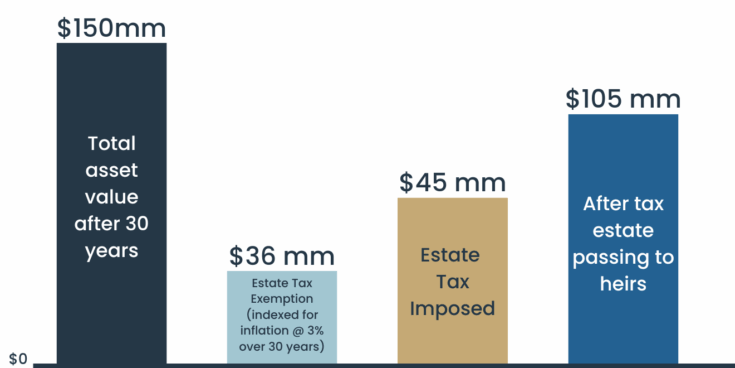
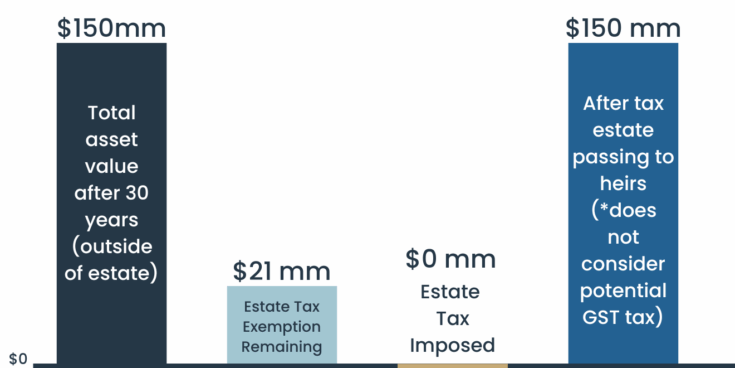
The charts below illustrate how gifting assets today can leverage the growth outside of your estate compared to waiting, even with inflation-adjusted exemption increases.

Gift at Death
The chart below assumes that a $15 million asset in your estate appreciates at 8% each year for 30 years. If you pass this asset to your heirs when you die in 30 years, assuming an estate tax exemption at such time of $36 million ($15 million indexed for 3% inflation), then the net taxable estate of $114 million would be taxed at 40% for a total of $45 million and an after-tax estate of $105 million passing to your heirs.

Gift Now
If instead you gift that asset now into an irrevocable trust for your heirs, the asset with absorb your entire tax exemption of $15 million (in 2026), but will grow tax-free, saving $45 million in tax (with an estate tax exemption of $21mm remaining for other assets).

Summary: Action Items & Planning Recommendations

StrategyBrief Explanation
Evaluate Lifetime GiftingGift appreciated assets now to transfer future growth out of the estate.
Set Up or Review Trust StructuresUse trusts to lock in exemptions and manage assets for beneficiaries.
Maximize GST Exemption UseWithout portability, make strategic GST-exempt gifts for each spouse.
Reassess Estate Plan TimingEarlier gifts may offer more leverage than waiting years.
Update Estate DocumentsEnsure wills, trusts, and related documents reflect the new exemption levels. If prior planning has been done around older, lower exemption amounts, there are opportunities to bring assets back into the estate, which can minimize capital gains at death.

Conclusion & Call to Action

The OBBBA has transformed estate-planning rules for high-net-worth families—elevating exemptions, preserving tax-efficient wealth transfers, and granting long-term clarity. However, state taxes and fine-print limitations underscore the need for careful and nuanced planning. With enough time and planning, estate taxes can be greatly reduced or eliminated entirely, even for estates well in excess of the new permanent exemptions.


Tobey Blanton Forney is a member of Kean Miller’s Estate Planning, Trusts, Successions & Probate group and practices in the firm’s Houston office. Tobey advises clients on their personal wealth, family, and legacy, helping them to not only manage their assets, minimize taxes, and put the right documents in place, but to translate their success into a meaningful legacy.

Enforcing a Fed. R. Civ. P. 45 subpoena against an expert is not for the faint of heart. Rarely invoked and often resisted, issuing a Rule 45 subpoena against an expert is tough to enforce but when it works, it can unlock critical discovery. Courts are often reluctant to compel an expert to produce anything beyond the disclosures required under Fed. R. Civ. P. 26, but some courts allow discovery of information beyond what Rule 26 requires expert disclosures to produce.

Differences Between Discovery Devices for Parties and Witnesses

The Federal Rules of Civil Procedure distinguish between discovery devices available against parties and those against nonparty witnesses.

  • Fed. R. Civ. P. 34 governs requests for production of documents from parties involved in the litigation. Rule 34 includes a specific provision regarding nonparties and references the ability to use Rule 45 against a nonparty.
  • Fed. R. Civ. P. 45 utilizes the subpoena power of the federal courts and allows parties to compel nonparties, including third-party vendors, experts and non-party witnesses to attend and testify for depositions and to produce requested documents through a properly issued Rule 45 subpoena.[1]
  • Fed. R. Civ. P. 26 governs the scope of expert discovery and mandatory disclosures in federal litigation, including the automatic disclosure of expert information without the need of additional discovery requests from the opposing party.[2]

The 2013 updates to Rule 45 establish that a subpoena must issue from the court presiding over the litigation, meaning that no matter where the non-party witness lives, the Rule 45 subpoena needs to be issued from the court where litigation is pending.[3] Using a Rule 45 subpoena gives attorneys the power to reach out-of-state experts, but it also provides jurisdictional safeguards for those experts, imposing compliance and commanding production of documents within 100 miles of where the person resides, is employed, or regularly transacts business.[4] It imposes responsibility on the party issuing the Rule 45 subpoena to take reasonable steps to avoid undue burden or expense and allows the person served to issue written objections and a court to quash or modify the subpoena.[5] 

Once a timely objection is lodged, Rule 45 triggers the ability to enforce the subpoena through a Motion to Compel, where the issuing party can request the court for an order compelling production or inspection.[6] Where the Motion to Compel is filed is important as it should be filed in the federal court where that expert is located, even if it that expert resides out of state.[7] This can mean litigating the enforcement of the Rule 45 subpoena in a different state than where the subpoena is issued (where the underlying litigation is) and sometimes even securing pro-hac vice admission to do it.

When is Rule 45 Worth the Fight?

Experts are not completely insulated from the reach of a properly issued Rule 45 subpoena. Various federal courts have recognized that Rule 26 does not limit or prohibit a party from requesting additional written information from an opponent’s testifying expert witness.[8] Arguably, a properly issued Rule 45 subpoena falls within the broad scope of Rule 26. As the Advisory Committee Notes made clear to the 1993 amendments, Rule 26 expressly recognizes that the required disclosures do not shut the door on traditional discovery methods to obtain further information.[9]

Rule 26 sets the floor, not the ceiling for expert discovery, and when more is needed, traditional discovery tools like a Rule 45 subpoena can be used to break through. Used strategically, Rule 45 is not just worth the extra fight, it can be the game changer in the litigation.


Amanda Collura-Day and Shiena Marie Burke are members of Kean Miller’s Casualty and Mass Tort Litigation group, which manages litigation dockets and tries cases for some of the leading companies in the United States. The team defends clients locally, regionally, and nationally in a wide variety of claims involving wrongful death, bodily injury, industrial accidents, chemical release or exposure, products liability, medical malpractice, workers compensation, as well as breach of contract and business disputes.


[1] Allstar Electronics, Inc. v. Honeywell Int’l, Inc., 8:10-CV-1516-T-30TGW, 2011 WL 4908853, *1 (M.D. Fla. Oct. 13, 2011).

[2] Fed. R. Civ. P. 26(a)(2).

[3] Fed. R. Civ. P. 45(a)(2).

[4] Fed. R. Civ. P. 45(c)(1)(A).

[5] Fed. R. Civ. P. 45(d)(3)(A)-(C).

[6] Fed. R. Civ. P. 45(d)(2)(B)(i)-(ii).

[7] Fed. R. Civ. P. 45(d)(2)(B)(i)-(ii).

[8] See, e.g., All W. Pet Supply Co. v. Hill’s Pet Prods. Div., 152 F.R.D. 634, 639 (D.Kan. 1993) (“With regard to nonparties such as plaintiff’s expert witness, a request for documents may be made by subpoena duces tecum pursuant to Rule 45.”); United States v. Bazaarvoice, Inc, No. C 13-00133 WHO (LB), 2013 WL 3784240, at *3 (N.D. Cal. July 18, 2013) (“Regardless of Bazaarvoice’s obligations under Rule 26(a)(2)(B), the government can use different discovery tools to illuminate and challenge expert testimony, as discussed above. A Rule 45 subpoena is such a mechanism.”); Roman v. City of Chicago, No. 20 C 1717, 2023 WL 121765, at *3 (N.D. Ill. Jan. 6, 2023); See Modjeska v. United Parcel Serv. Inc., 2014 WL 2807531, at *6 (E.D. Wis. June 19, 2014) (“Rule 26(a)(2)(B) governs only disclosure in expert reports, however, and it does not preclude parties from obtaining further information through ordinary discovery tools.”); see also Est. of Jackson v. Billingslea, 2019 WL 2743750, at *4 (E.D. Mich. July 1, 2019) (“[C]ourts routinely allow discovery of information beyond what 26(a)(2)(B) requires.”); Izzo v. Wal-Mart Stores, Inc., 2016 WL 593532, at *2 (D. Nev. Feb. 11, 2016) (“[W]here a party seeks addition [sic] information regarding the expert’s opinion, she may seek to obtain that information through the discovery process.”).

[9] Fed. R. Civ. P. 26(a)(2)(B) advisory committee’s note (1993 amendments).

The Collateral Source Rule is a common issue in almost every personal injury case, but its application can vary significantly from state-to-state. At its core, the rule is intended to ensure that the party responsible for the harm (the tortfeasor) is held fully accountable for the injuries they caused – and that they do not benefit from the plaintiff’s decision to obtain insurance or other benefits. While both Texas and Louisiana recognize the collateral source rule, they apply it with notable differences, particularly concerning statutory exceptions and its impact on medical damages.

Texas – Collateral Source Rule

In Texas, the collateral source rule is well-established and frequently applied in personal injury litigation. However, several key exceptions can significantly impact how medical expenses are calculated and what the plaintiff may ultimately recover from the tortfeasor.

  • General Rule – The rule generally prohibits the defendant from introducing evidence that the plaintiff’s medical bills were paid by a third party (i.e., health insurer, workers’ compensation carrier, etc.). The rationale behind this rule is that the wrongdoer should not benefit from the victim’s foresight in securing their own insurance.
  • Medical Expense Exception – Texas law does not allow a plaintiff to recover more than the amount actually paid for medical expenses by an insurance provider. This principle is commonly known as the “Paid or Incurred” rule and is codified in Texas Civil Practice and Remedies Code § 41.0105. The Texas Supreme Court has explained that if a plaintiff’s insurer has negotiated a lower rate and the healthcare provider accepts that reduced rate as payment in full, the plaintiff can only recover the lower rate. The difference between the billed amount and the paid amount is considered a “phantom damage” because the plaintiff was never responsible for it. This is a significant limitation on the collateral source rule, when applied and argued correctly.
  • Other Notable Exceptions
    • Tortfeasor’s Insurance: In cases where the alleged tortfeasor’s own insurance company has paid the plaintiff’s expenses, the collateral source rule should not apply to those payments, and those payments should be deducted from the damages ultimately owed.
    • Subrogation: The collateral source rule does not impact or eliminate an insurer’s right of subrogation. If an insurer has paid the plaintiff’s expenses, it may still seek reimbursement for those expenses from the tortfeasor or from the plaintiff’s recovery.
    • Impeachment Evidence: In limited instances, evidence of collateral source payments may be admissible to impeach a witness, though such situations are rare and depend entirely on the witness’s testimony.
  • Impact on Evidence at Trial Typically, the jury is not informed of the source of the payment (i.e., insurance). Rather, the jury is shown only the amount paid. This rule can cut both ways – as it prevents the jury from seeing the full, billed amount of the medical expenses, and also prevents evidence of the amounts written off due to negotiated discounts (i.e., the “phantom damages”).

Louisiana – Collateral Source Rule

For the longest time, Louisiana’s approach to the collateral source rule was considered one of the “stricter” collateral source states by comparison to other states. In recent years, there has been extensive change to the collateral source rule in Louisiana – through both the courts and the legislature.

  • General Rule Louisiana courts consistently hold that a defendant is not entitled to any credit for payments the plaintiff received from a collateral source. This includes insurance, social security, workers’ compensation, or even charitable donations.
  • Medical Expense Exceptions While Louisiana does not have the “Paid or Incurred” rule that Texas has, there are a few exceptions to the collateral source rule’s application dependent upon the source of the medical expense payments. In the last 20 years, the Louisiana Supreme Court has addressed whether medical expenses or rates set by Medicaid, the Workers’ Compensation Medical Reimbursement Fee Schedule, or by an agreement negotiated between the plaintiff’s lawyer and plaintiff’s doctor should be subject to the collateral source rule. However, it was not until recent years that the Louisiana legislature addressed these issues with the enactment of various versions of La. R.S. 9:2800.27.
    • No “Paid or Incurred” Limitation: Unlike Texas, Louisiana law does not always limit a plaintiff’s recovery to the amount actually paid by insurance in every situation.
    • Medicaid Payments: The collateral source rule does not apply to medical expense write-offs from Medicaid. Plaintiff’s recovery for medical expenses paid by Medicaid should be limited to the amount Medicaid actually paid to the healthcare provider. Medicaid is a form of free medical service. Applying the collateral source rule to these payments would allow the plaintiff to recover the written-off amount and “pocket the windfall” of charges plaintiff was never obligated to pay. This is codified in La. R.S. 9:2800.27(C).
    • Workers’ Compensation Medical Payments: The collateral source rule does not apply to amounts that were written off pursuant to the Louisiana Workers’ Compensation Medical Reimbursement Fee Schedule – a statutory list of charges for medical treatment, typically less than charges made outside of the workers’ compensation system. (Note: This Fee Schedule is currently undergoing a legislative update). Again, because these charges are statutorily set, the plaintiff would never be obligated to pay the full charges. This is codified in La. R.S. 9:2800.27(D).
    • Attorney Negotiated Reduced Rates: In many cases, the plaintiff’s lawyer has a relationship with the plaintiff’s doctor and as a result of that relationship the doctor may agree to accept a lower amount for the medical services than what the doctor actually bills. When this happens, the collateral source rule does not apply to these medical expense write-offs resulting from attorney’s negotiation. The plaintiff’s recovery should be limited to what was actually paid to the medical provider. This is in La. R.S. 9:2800.27(G).
    • Medicare and Health Insurance Payments: In cases where the medical expenses have been paid, in whole or partially, by a health insurer or Medicare to a healthcare provider, the recovery of those medical expenses should be limited to the amount actually paid, plus any applicable cost sharing amounts paid or owed by the claimant – not the full amount billed. The phrase “cost sharing” is defined in the new 2025 legislation as, any “copayments, coinsurance, deductibles, and any other amounts which have been paid or are owed by the claimant to a medical provider.”
    • Louisiana Civil Justice Reform Act: Originally passed in 2020, this legislation was amended again in 2025, addressing the collateral source rule and recovery of past medical expenses. Due to the infancy of this act, time will tell how it impacts medical expense in personal injury litigation recovery moving forward. The full, current version can be found here – La. R.S. 9:2800.27.
  • Impact on Evidence at Trial – The factfinder should be informed of both the amount billed by the medical provider and the amount actually paid for the medical services. This is a fairly new change in the law, as the jury was previously only told of the amount billed – not what was paid.

Examples of Using These Tools to Reduce Damages

Kean Miller’s team has repeatedly used the above law and arguments to successfully reduce our client’s exposure prior to trial.  Below are a few examples of Kean Miller’s team reducing the plaintiff’s claimed medical special damages (what was charged) to the amount actually paid.

  • From $345,233 to $79,854 – Reduction based on workers’ compensation payments. Products liability claim, amputated leg.
  • From $311,684 to $83,542 – Reduction based on Medicaid payments and attorney negotiated write-offs. Automobile accident, neck and lower back injuries.
  • From $278,457 to $104,652 – Reduction based on workers’ compensation payments and attorney negotiated write-offs. Industrial accident at petrochemical facility, head trauma and spinal injuries.
  • From $153,468 to $86,342 – Reduction based on workers’ compensation payments. Industrial accident at natural gas storage and processing facility.
  • From $106,789 to $22,861 – Reduction based on workers’ compensation payments and attorney negotiated write-offs. Automobile accident, neck and lower back injuries.

Takeaway

Despite being neighboring states, Texas and Louisiana’s application of the collateral source rule can differ significantly. If you or your company are found defending a personal injury matter in either state, understanding the distinction in each state’s application of the collateral source rule is crucial to accurately evaluate potential damages, implement a defense to minimize tort exposure, and strategize a defense.


Forrest Guedry and John Hogg are members of Kean Miller’s Casualty and Mass Tort Litigation group, which manages litigation dockets and tries cases for some of the leading companies in the United States. The team defends clients locally, regionally, and nationally in a wide variety of claims involving wrongful death, bodily injury, industrial accidents, chemical release or exposure, products liability, medical malpractice, workers compensation, as well as breach of contract and business disputes.

In offshore operations, whether a contract is deemed “maritime” has major consequences. The classification determines the application of either federal maritime law or state law, along with its oilfield or construction anti-indemnity statutes for states such as Texas or Louisiana. The difference often decides whether the defense, indemnity, and insurance-related obligations in the contract survive (under maritime law) or are voided (under certain state’s laws), directly impacting risk allocation between operators and contractors.

Current Fifth Circuit Framework

Two recent United States Fifth Circuit Court of Appeals decisions highlight where the law currently stands, and what contractors and operators should keep in mind when drafting and enforcing service contracts. This is particularly important given that the case law generally ignores or gives little weight to contractual choice-of-law provisions in these types of contracts, even when the parties designate federal maritime law under the hope that the indemnity obligations will be enforceable.

The Doiron Two-Step Test

Since 2018, courts within the Fifth Circuit have applied the two-inquiry test from In Re Larry Doiron, Inc., 879 F.3d 568 (5th Cir. 2018):

  1. Does the contract to provide services to facilitate the drilling or production of oil and gas on navigable waters?; and
  2. Does the contract provide or do the parties expect that a vessel will play a substantial role in the completion of the contract?

An affirmative answer to both questions classifies the contract as maritime, subject to federal maritime law. Whereas, a negative answer to either question means that state law applies, either directly if the claim arose onshore or in state waters, or through the Outer Continental Shelf Lands Act (“OCSLA”) if the claim arose offshore on the OCS.

Earnest v. Palfinger: Vessel’s Role, Not Its Use, Guides Maritime Contract Classification

Recently, the Fifth Circuit has narrowed the scope of maritime contract classification, specifically with regard to the role of a vessel in a contract. In Earnest v. Palfinger Marine USA, Incorporated, 90 F.4th 804 (5th Cir. 2024), the Fifth Circuit reversed the district court and held that a contract for the upkeep of lifeboats on an oil production platform was a maritime contract.

In finding that the contract was not a maritime contract, the district court focused on the fact that the lifeboats were not used in connection with traditional maritime activities but were instead safety equipment required for the operation of an OCS platform. The Fifth Circuit disagreed and emphasized that the “use” of the vessel is less important than whether a vessel plays a substantial role in the performance of the contract. The lifeboats were central to Palfinger’s contract, even though they weren’t used to perform the work. This decision is significant in clarifying that a contract may still be deemed maritime even if the vessels involved are not directly engaged in “maritime commerce” at the moment of the contracted services, so long as they play an integral role in facilitating a maritime commercial activity.

Offshore Oil Services v. Island Operating Company: Incidental Vessel Use Isn’t Enough

Just this month, the Fifth Circuit reached the opposite conclusion in Offshore Oil Services, Inc. v. Island Operating Company, Inc., et al, 2025 WL 2541914 (5th Cir. Sept. 4, 2025). In this case, the dispute arose after a contract operator was injured during a personnel basket transfer from a vessel onto a platform on the Outer Continental Shelf.

The issue before the Court was whether the Master Service Contract (“MSC”) between the operator and owner of the platform was a maritime contract, such that indemnity would be owed to the vessel owner and platform operator from the contractor’s employer. The Fifth Circuit found that the MSC covered lease and production operations, not vessel services, and therefore was not a maritime contract.

According to the Fifth Circuit, the vessel use was limited to transportation, which was merely incidental to the work itself. The Court emphasized that simply referencing vessels, or using them for crew transport, does not transform a contract into a maritime one. The Court rejected arguments that actual vessel use (e.g., water transfers, equipment loading) automatically made the contract maritime, clarifying that such tasks do not override the parties’ expectations or the contract’s scope.

Further, the Court distinguished Earnest, noting that the contract there involved repair and maintenance of vessels necessary to support offshore drilling and production of oil and gas (i.e., maritime commerce), which inevitably gave the vessel a substantial role. By contrast, the MSC at issue contemplated no requirements resembling such work, but instead called for services traditionally related to oil and gas production that courts have consistently considered nonmaritime, even when performed on an offshore platform. The Fifth Circuit echoed Doiron’s central holding: contracts for non-maritime services do not become maritime simply because employees occasionally perform vessel-related tasks.

Key Takeaways for Operators and Contractors

These cases confirm that the Fifth Circuit is applying Doiron narrowly. Contracts for non-maritime services do not become maritime merely because they reference vessels or employees occasionally perform vessel-related tasks. The existence of a vessel and the contemplation between the parties of the role that a vessel will play in the execution of the contract is crucial. The vessel must play an integral role in facilitating a maritime commercial activity for the contract to be deemed maritime. Operators and contractors should draft MSCs with this framework in mind, as classification can determine whether indemnity obligations survive under maritime law or are invalidated by a state’s anti-indemnity laws.


Lauren Guichard Hoskin is a member of Kean Miller’s Offshore Energy & Marine group and practices in the firm’s New Orleans office. She has successfully handled and resolved lawsuits involving maritime personal injury claims, oil and gas casualty and property damage claims, drilling accidents, well blowouts, and various breach of contract disputes.

Within the last year, the legal industry has witnessed a surge in AI-based programs designed to improve workflow, legal research, and legal drafting, such as Westlaw Co-counsel. AI technology, although new, offers significant benefits for helping attorneys enhance their workflow. However, it is not a substitute for an attorney’s legal knowledge, skill, and independent judgment.

Recent headlines highlight egregious examples of attorneys using AI to write briefs, which include fictional cases, or a pro se plaintiff attempting to use an AI-generated attorney in court. Although these are extreme examples, they underscore the importance of sound legal judgment when using AI. Attorneys’ use of AI technologies will not only become standard practice but will also be essential for improving productivity and streamlining case workflow.

How AI Can Help Attorneys Improve Workflow in a Typical Case

  • Electronically Stored Information and Discovery: One of the most significant advancements in legal AI involves discovery. In written discovery, AI can assist in generating standard questions tailored to specific legal issues. This not only saves time but also helps attorneys formulate effective questions in unfamiliar areas of law. Regarding document productions and electronically stored information (ESI), AI can analyze large volumes of ESI to identify specific information. For example, AI can review and prepare a timeline based on the underlying documents and identify documents that involve specific factual or legal issues, e.g., evidence of fraud or breaches of contract. Again, AI is not a replacement for independently reviewing documents or preparing discovery requests, but it can be used as a starting point to give context to an issue or start the document review process.
  • Initial and Niche Research: AI can also provide a valuable resource when conducting legal research. For example, Westlaw has an integrated AI mechanism to help conduct legal research. Not perfect, but the AI search engine can help identify case law, secondary sources, or code articles relevant to the underlying issue. This method is usually a good starting point when researching a new area of law or a niche legal issue. At the bare minimum, using AI to conduct legal research will identify common legal terms or issues associated with the underlying issue, which can help generate more pointed Boolean searches.
  • Deposition Preparation and Completion: From start to finish, AI can help attorneys both before and after a deposition. Before taking a deposition, AI can help prepare potential questions for a witness based on case documents. For example, if there is an upcoming expert deposition, AI can compare prior expert deposition (great for witnesses who have testified before or multiple times), identify gaps in the expert’s reasoning or analysis, and compare and analyze prior expert testimony. After the deposition, AI can help: (i) summarize the deposition for client correspondence or internal records; and (ii) identify and cite to a witness’s testimony on specific topics to use at trial. These uses do not relieve an attorney from verifying the information or checking the AI’s analysis but can drastically increase productivity.
  • Alleviate Writer’s Block: Writing briefs, motions, exceptions, or letters can sometimes be a daunting task for any attorney. Young and old attorneys alike will, at some point in their writing careers, find themselves trying to figure out how to structure a sentence or organize a paragraph. Previously, the options were to push through or delay figuring out the best structure or organization, but now AI can alleviate some pressure and potentially break writer’s block. For example, AI can review sentences and paragraphs, providing suggested revisions or alternative sentence structure. Simple suggestions or revisions can improve motions, briefs, or other written materials. Additionally, AI can be a useful tool for editing and revising grammar or spelling errors.

As indicated, AI has its uses in the legal field. Is it perfect? Is it going to replace attorneys? The answer – no. Attorneys still need to exercise legal judgment, review documents, draft briefs/motions, and double check AI’s work because AI hallucinations and false information continue to be a major pitfall in using the technology. However, AI can and will need to be used to help attorneys improve their workflow and become more efficient. Arguably, AI will allow attorneys to get back to what they do best – think, strategize, and plan.

In summary, AI is not a substitute for the experience and judgment of a skilled attorney, but it can be a powerful tool for making legal work more efficient. When attorneys use AI for tasks like discovery, research, depositions, and drafting, they can spend more time on strategy and planning. Still, it’s important for lawyers to use their own judgment, double check AI’s work and keep ethical standards in mind when working with AI, always respecting their clients’ policies and/or restrictions on AI use. As AI develops, it will likely play an even bigger role in legal practice, opening new ways to work smarter and more effectively.


Michael Levatino, Kelicia Raya, and Claire Juneau are members of Kean Miller’s Energy & Environmental Litigation group, which represents energy and petrochemical clients in litigation involving environmental contamination claims related to oil, gas, and petrochemical operations; wetlands, land loss, and erosion claims; NORM defense; superfunds; and midstream operations and pipelines.

Since 1991, the Telephone Consumer Protection Act of 1991 (“TCPA”) has protected consumers from unwanted and intrusive telemarketing practices at the federal level. Several states also enacted their own telephone solicitation laws that mirror or add further protection to consumers in their state, known as “mini-TCPA” laws. A growing number of states further strengthened their telemarketing rules after the U.S. Supreme Court’s narrowing of TPCA dialing technology regulation in Facebook v. Duguid, 141 S.Ct. 1163 (2021).

Texas’s mini-TCPA (hereinafter “TX-TCPA”) has been on the books since 2009 (See Texas Business & Commerce Code, Title 10(A)). On June 20, 2025, Governor Abbot signed Texas Senate Bill 140, which significantly changed telephone marketing regulations in Texas. Despite testimony from the bill’s sponsors that curbing unwanted and unsolicited telephone communications is the goal, SB 140’s broad changes impose heightened compliance obligations on businesses sending nearly any text solicitations—even when they have the recipient’s consent. Violations of the TX-TCPA carry heavy penalties and the new amendments simplify bringing private rights of action, so businesses sending texts to Texas residents should evaluate any new compliance obligations before sending further texts.

The TX-TCPA changes became effective on September 1, 2025. This article summarizes the various changes and obligations now in effect for businesses that are or will be texting Texas residents as part of their marketing strategy.

1. Text Messages Added to Definition of “Telephone Solicitation”

Before SB 140, a telephone solicitation meant only a telephone call. That limitation is removed, and a telephone solicitation now includes: “a call or other transmission, including a transmission of a text or graphic message or of an image, initiated by a seller or salesperson to induce a person to purchase, rent, claim, or receive an item.” (Tex. Bus. & Com. Code § 302.001(7)). While on its face such a change does not seem significant considering the FCC’s past interpretation of text messages falling under various aspects of the TCPA (though those agency interpretations continue to be called into serious doubt after Supreme Court opinions issued in 2024 and 2025). And yet, this change places significant regulatory burden on businesses to continue texting inside of and to residents of Texas. Section 302 of the TX-TCPA specifically obligates businesses who make telephone solicitations (now including text messages) to register with the Texas Secretary of State as a telemarketer.

Registration forms can be found on the Texas Secretary of State’s website. In addition to registration, a covered seller must pay a $200 filing fee and provide a $10,000 bond or other security. They must also provide certain public facing disclosures under Section 302, post a copy of their registration certificate online, and regularly renew that certificate.

Importantly, the obligation to register is on the seller, which is the entity that is soliciting business through the text message. The obligation is not on the individual person or entity that facilitates the texting, so using a third party to send the messages will not allow a company to avoid liability for non-registration. Sections 302.051–061 do provide several exceptions to the registration requirement, so companies should evaluate whether they could fall under an exception when assessing their regulatory obligations. Violations of Section 302 carry statutory damages of $5,000 per violation plus recovery of fees and costs.

2. Certain Telephone Marketing Violations Now an Automatic Violation of the Texas Deceptive Trade Practices Act.

Chapters 304 and 305 generally regulate telephone marketing through consent or opt-in requirements, mandatory disclosures to recipients, no-call lists, and similar requirements. SB 140 did not add or remove any of these obligations; instead, it made violations of those chapters automatic violations of the Texas Deceptive Trade Practices and Consumer Protection Act (DTPA). The DTPA tie-in now allows potential plaintiffs easier paths to litigation without meeting the cumbersome administrative prerequisites provided in Section 304. Claims under the DTPA also allow for mental anguish, economic damages, treble damages for intentional conduct, and mandatory recovery of attorney’s fees and costs.

Texas was already a hotspot for TCPA class actions before SB 140. We expect that trend to continue, if not increase, in response to the additional avenues for recovery.

3. SB 140 Increases Risk of Claim Stacking.

Beyond providing an additional avenue for recovery under the DTPA, SB 140 also makes explicit that multiple legal recoveries for the same violation will not be a bar against additional future recovery: “The fact that a claimant has recovered under a private action arising from a violation of this chapter more than once may not limit recovery in a future legal proceeding in any manner.” How this addition will operate remains to be seen. But Texas courts have allowed recovery before under both the TCPA and the TX-TCPA, so companies who settle or pay judgments for TCPA class actions pending outside of Texas on a class basis may later find themselves subject to further litigation in Texas arising out of the same telephone calls or texts. The DPTA conversely prohibits cumulative recovery for the same violation, so full impact remains to be seen.

4. The TX-TCPA Confirms Criticality of Compliance Programs.

SB 140 has raised the stakes on telemarketing litigation and associated risk in texting Texas residents. 2024 saw the highest number of class actions filed in a single year, and 2025 has already nearly doubled that amount.[1] At least 7 new TCPA actions have been filed in Texas federal court since September 1, and several include claims arising from SB 140’s changes. Companies that intend to continue texting Texas residences should be sure that their texting practices and policies are updated to account for any new obligations.


Jessica Engler, PLS, CIPP/US, CIPM is a Partner and the Chair of Kean Miller’s Data Privacy & Cybersecurity group. She is a Privacy Law Specialist, as designated by the International Association of Privacy Professionals and accredited by the American Bar Association.


[1] Eric Troutman, “Midyear Litigation Report: TCPA Class Actions Up Staggering 95.2% from 2024—Previously the Highest Year on Record,” TCPAWorld.com (Jul. 25, 2025) (MIDYEAR LITIGATION REPORT: TCPA Class Actions Up Staggering 95.2% from 2024-Previously the Highest Year On Record – TCPAWorld).